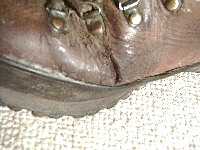
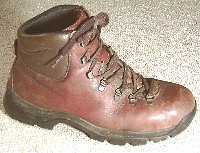
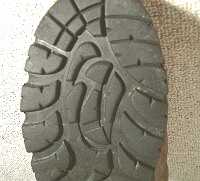
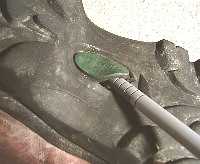
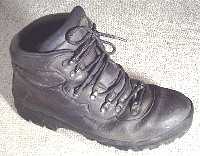
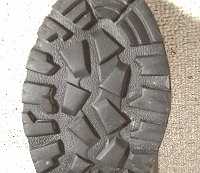
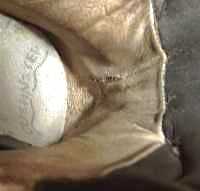
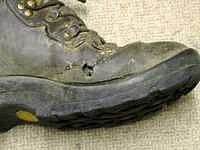
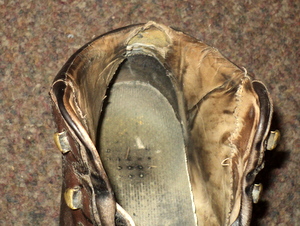
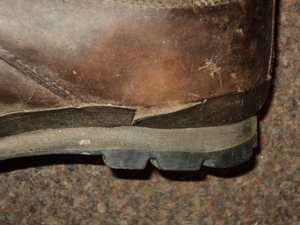
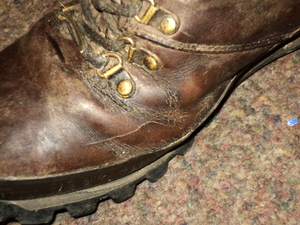
Boots - The Most Vital Part of a Walkers Equipment
I am generally of the opinion that it is not necessary to spend large sums of money on the very latest in walking equipment - suitable equipment for use in all but the most severe weather conditions can be bought for a modest price and can perform quite adequately for the type of walking detailed in these diaries.
There is one part of a walker's equipment, however, which should be given much more consideration than anything else, and that is footwear. Badly chosen footwear can be responsible for endless pain and misery and can ruin the enjoyment of a walk, so it is essential to make sure at the outset, that footwear is comfortable, fits properly and is suitable for the terrain and weather conditions that are likely to be encountered throughout the walk.
In the early days of my walking, the only real option when buying boots was to go to one of the well known outdoor shops where prices were not always very competative. Somewhat later, I discovered a shop that had a lot of discounted stock (probably surplus stock from elsewhere) but they did not have a full range of sizes so it was a matter of finding ones that would fit and choosing the most suitable ones of those. Later, online selling became much more of a thing which opened a lot more competition on prices with a wide range of makes and sizes available. Hence it was possible to buy high quality boots without having to spend a fortune. The only disadvantage of this was that they couldn't be tried on for fitting and comfort or compared with other boots. To overcome this, sellers were often prepared to accept returns and would replace them with other sizes or makes. This always seemed rather wasteful on postage so I generally avoided it and tended to buy online only if I were fairly sure of what I wanted. However, it has now become much more of the norm for sellers to accept this returns now that there is a lot of competition between couriers to reduce delivery costs.
For most of the long distance walks that are detailed here, boots are the only sensible choice, although some walks which stick mainly to well established footpaths over less severe terrain could be attempted in trainers if the weather is not too wet. However, my choice has always been to use walking boots, so the following comments refer to those.
It should be noted that most of the boots referred to here are probably no longer obtainable, as designs change very frequently. However, these comparisons can still be useful when looking at general issues regarding boot construction.
Fabric or Leather
These days there is vast range of boots to choose from at prices from less than £30 to well over £100 and in a variety of different materials, from traditional leather to fabric and synthetic materials. There is also a lot of high technology design incorporated into many boots to improve water resistance and to provide cushioning on the soles as well as a variety of other features. The boots I have worn have all fallen into the medium price bracket, but have varied considerably in design and construction, which has given me an insight into the pros and cons of some of these features.
Probably the most significant starting point is the choice of leather or fabric for the construction of the uppers and here I will list some of the features of each type.
Conventional Leather
Fabric/Synthetic
Waterproofing
Good
Poor but improved by GORE-TEX® lining
Comfort
Hard Leather can take a long time to
'break in'.
Footbed sometimes very solid, needing extra insoles for comfort.
Instant comfort from first wearing
Weight
Generally heavier, though some are of lighter construction
Generally lighter
Cleaning
Mud often sticks to leather and has to be
scraped and washed off.
Materials are generally water repellent
so mud does not stick. Remaining mud brushes off easily
when dry.
Re-proofing
Dubbin or wax preparations
Liquid waterproofing agent
Common faults
Leather cracks where most flexing occurs.
Stitching rots or frays.
Footbed disintegrates.
GORE-TEX® lining wears through.
Stitching rots or frays.
Fabric tears (not very common)
Drying
Fairly slow
Very slow when soaking wet
Hawkins Leather Boots
Life
At least a thousand miles of walking over rough terrain.
Cost
Approximately £35 in 1991 (equivalent to £103 approx in 2023)
Comfort
I bought these boots for my first long distance walk - The Pennine Way in 1991. Unfortunately, they were thrown away some years ago, so I am not able to show any photographs of wear and
tear. They were of a conventional design and were reasonably comfortable once thay had been broken in, although I suffered badly from rubbing against my ankle bone in the early stages. I do not blame this entirely on the boots, as I was walking 'on the double' during training, which caused far more problems than if I had just been walking normally. I did also suffer somewhat with aching feet on the Pennine Way, but this was my first long distance walk and my feet were not as well conditioned to the rigours of this sort of walking.
Water Resistance
These boots were reasonably waterproof, but not particularly good in prolonged wet conditions. However, being of conventional construction, they were not too difficult to dry when they did get wet. There were some problems with stitching coming adrift in the latter stages and this seriously detracted from there water resistance, even when the stitching was repaired.
Wear
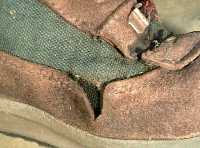
I did not keep a record of how many miles these boots did, but a rough calculation shows that it must have been at least a thousand miles. At this stage they were suffering from a number of things - worn out soles, worn out stitching and finally cracks in the leather where the uppers joined the soles near the ball of the foot, where most of the flexing takes place.
Good Points
Reasonably comfortable after breaking in
Gave good service for at least a thousand miles
Bad Points
Took a long time to break in - about 500 miles before
they were really comfortable
Not as good as some boots for keeping out water
General Assessment
Traditional boots which gave good reliable service over many
miles and were, therefore, good value for money.
Daisy Roots Leather Boots
Daisy Root Boots after 1140 Miles
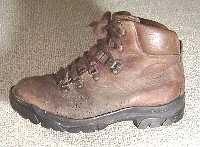
General view of Daisy Root boot
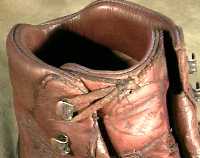
Nut and bolt with washer inside, used to repair torn out lace hook
Wear to sole - very good for 1140 miles
Slight cracking of leather causing some water penetration
Cost
Approximately £50 in 1993 (equivalent to £138 approx in 2023)
(equivalent to £138 approx in 2023)
Comfort
Comfort is the last word that comes to mind with these boots.Everything about them is unyielding, from the very tough leather of the uppers to the very solid plastic footbed. All this made the boots almost indestructible, but caused untold agonies, particularly on long walks. The leather padding around the ankles was still quite stiff despite liberal application of wax, and this caused me a lot of discomfort on my ankle bones, the uppers and footbed were so rigid that they didn't flex easily and this put further strain on the ankles. The solid footbed meant that all the weight was taken on small pressure points on the ball of the foot and the heel and this induced agony after a few days of continuous walking.
It is true that the latter problem could have been solved by the use of thick insoles but, unfortunately, the boots were rather narrow fitting and did not have enough room to accommodate these without making them tight on the foot - a problem which could have been picked up at the fitting and buying stage rather than when it was too late.
Water Resistance
These boots were reasonably watertight but never very good. I never found exactly where water entered, but I assumed it must have been through the stitching. Later in their life, some slight cracking of the leather where it flexed resulted in more water penetration, but this was reduced by liberal application of wax.
Wear
The soles still had a considerable amount of tread left after well over a thousand miles and the uppers were also in remarkably good condition even after using the boots for working. They are virtually indestructible.
Good Points
Long lasting and very durable
Kept good appearance
Good foot protection
Good grip
Bad Points
Tough leather bad for comfort
Narrow fitting with little room for extra insoles
General Assessment
These boots seemed more suitable as working boots than walking boots as they offer very good foot protection - who needs steel toe-caps with leather as solid as this! For shorter walks, where the lack of comfort is not so noticeable, they could provide very long and reliable service and certainly provide very good value for money in terms of pounds per mile. However, for long distance walking I was heartily glad when I replaced them and could again walk in comfort. I still keep them as working boots and I am sure they will last me a long time in that capacity.
Hi Tec Fabric Boots
Hi Tec Boots after 170 Miles
General view of Hi Tec boot
Some wear to sole
Cost
Approximately £35 in 1994 (equivalent to about £95 in 2023)
Comfort
These boots were my first venture into fabric boots and I bought them, not so much as a replacement for my main walking boots, but as a more comfortable alternative to the Daisy Roots for summer use in dry conditions. They were a vast improvement for comfort, but not a serious walking boot in any other respect, although they did suit the purpose at the time. Because of their limitations, I have only worn them on limited occasions, so have not really been able to evaluate them over a high mileage.
Water Resistance
These boots lack the GORE-TEX® lining of more expensive fabric boots and also have a tongue which is not designed to keep out water in deep puddles. After a short time in wet grass it is apparent that water resistence is not one of their strong points, but for summer walking in reasonably dry conditions they are fine.
Wear
I have not done enough mileage in these boots to properly evaluate how well they would stand up to wear, but so far they have done quite well, although I doubt very much whether they would come into the thousand mile category, but they would brobably last for several hundred miles.
Good Points
Quite comfortable from the outset
Light weight
Bad Points
Poor water resistance
General Assessment
Although these are sold as walking boots, they are not really suitable for serious walking in wet and boggy conditions. They are more akin to heavy duty trainers with a deeper tread, and as such, are only suitable for easy walking in fairly dry conditions. They did, however, prove to me how much more comfortable canvas boots could be and persuaded me to change to canvas boots next time I needed a new pair of main walking boots.
Line 7 Fabric Boots
Please note that Line 7 were taken over by Aigle around about 2000, so their boots are no longer available
Line 7 Fabric Boots after 1065 Miles
General view of Line 7 boot
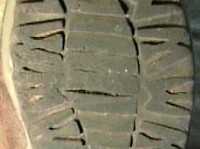
Cracking at flexing point
Right boot has worn unevenly and leans to right. Left boot remained level.
Wear and cracking of sole
GORE-TEX® lining worn through on right boot - left boot OK
Comfort
Approximately £60 in 1995 (reduced from about £70)
Comfort
Of all the boots I have ever worn, these have been the most comfortable right from the start. It helps that they were wide fitting, not too tight and suited to the shape of my feet. Without any extra insoles, these boots were comfortable on all sorts of terrain. They may not have given as much support and protection as some more solidly constructed boots, but this was a small price to pay for the general comfort.
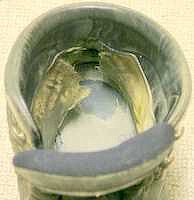
This comfort, however, deteriorated after about 400 miles when I found that my heels were hurting after several miles of walking. This was caused by disintegration of the footbed and was only cured by slitting open the GORE-TEX® lining and filling all the hollow cavities with silicone bath sealant (for want of anything better to do). I also used the sealant to stick down the Gore-Tex where I had slit it and managed to retain much of the water resisant properties.
Water Resistance
These boots gave the impression of being very watertight at first, but I realised after some time that the water was actually penetrating the boot but not penetrating the GORE-TEX® lining. This was not a problem in moderately wet conditions, but in very wet conditions the boots tended to fill up with water in the hollows between sole and footbed and then took a very long time to dry out.
Wear
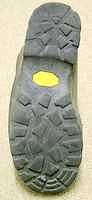
The sole had a less chunky tread than on most other walking boots. This was fine for walking in dry conditions, but gave somewhat less grip in soft mud. As the tread wore down this was more apparent. After a thousand miles the tread in the middle of the sole and back of the heels had worn virtually flat and cracks had started to appear in the soles, although not yet bad enough to let in water. The tread on most boots is fairly well worn out over this mileage, but some boots do manage to retain a bit more grip than these.
Wear on the uppers was less of a problem as most of it was superficial and did not cause any deterioration of the functioning of the boots.
The right boot seemed to wear unevenly, causing it to lean over to the right and hence my foot rubbed against the Gore-Tex lining more than normal causing it to wear right through. Whether this was caused by my walking unevenly, or by some tendency of the boot to lean over, I am not sure, but this has not tended to happen with other boots.
Good Points
Comfort
Light Weight
Easy to Clean (almost self-cleaning as mud did not stick)
Bad Points
Footbed broke up after only 400 miles
Soles had less grip and wore more quickly than some boots
General Assessment
Very good boots that gave me a lot of very comfortable and dry walking, marred only by the fact that I had to undertake some fairly major repairs less than half way through their life. In the end I got over a thousand miles of walking out of them, which is all I can really ask of them, so they served me very well.
NeeBee Fabric Boots
Please note that Neebee have now gone out of business so their boots are no longer available
NeeBee Boots after 850 Miles
General view of NeeBee boot
Badly worn sole
Stitching torn apart on both boots, also cracking at flexing point
Cost
Approximately £60 in 1997 - reduced from about £70 (equivalent to about £148 in 2023)
Comfort
These boots gave a good level of comfort from the outset, although not quite as comfortable as the Line 7 boots. They had a more chunky tread, which gave a better feeling of security in mud than did the Line 7 boots.
The comfort, as with the Line 7 boots, deteriorated after about 400 miles when the footbed disintegrated into a soggy mess leaving only the honeycomb construction underneath to support the foot. This was, no doubt, caused by using the boots for too long in a damp condition without thoroughly drying them out between
walks. However, it was only cured by slitting open the Gore-Tex lining and inserting some homemade footbeds as replacements. The boots were never quite the same again, although this did manage to extend their life.
Water Resistance
As with the Line 7 boots, these boots gave the impression of being quite watertight at first, although not quite as good as the Line 7 boots. Again, this was mainly due to the Gore-Tex lining keeping wet from the feet rather than the boots themselves keeping out water. In very wet conditions the boots tended to fill up with water in the hollows between sole and footbed and then took a very long time to dry out. This is one of the reasons for the footbed problems mentioned above. After repairs had been carried out, the level of water resistance was worse, as the Gore-Tex lining was no longer completely intact.
Wear
The soles were well worn in parts after only 850 miles, which was not so good as other boots, particularly the leather ones. The stitching near the heel of both boots came adrift mainly because of the tendency for it to catch against the other boot or other objects whilst walking. The best boot designs do not have
sewn joints at their widest points but further round, where the boot is narrower and there is less chance of them catching on things. There was also some cracking where the boot flexes most, as tends to occur with most boots. However, this was only superficial as the fabric was still intact.
Good Points
Good level of comfort from the outset
Good grip from the soles
Fair resistance to water
Bad Points
Footbed broke up after only 400 miles
Soles fairly well worn after 850 miles
General Assessment
Quite good boots that gave me a reasonable amount of comfortable walking. The footbed problems were a nuisance and could well result in some people throwing the boots away. I managed to affect repairs which extended their life, but I needed an extra insole after the repairs, which made the boots rather tight and less comfortable. Although the boots were not completely worn out after 850 miles, they would not give a lot more useful service, so have not lived up to my thousand mile expectations.
Berghaus Leather Boots
Berghaus Boots after over 1400 Miles
General view of Berghaus boot with 'one piece' leather construction
Loop of bootlace sewn on to prevent the tongue from sliding round to one side
Only Moderate Wear to sole
Rand coming completely adrift; also deep cracks in leather
Cost
£60 in 1999 - reduced from £90 (equivalent to about £140 in 2023)
Comfort
I knew from the first fitting of these boots that they were going to be comfortable. They had a good, wide fitting with plenty of room for my feet without them slopping about. The leather was very supple, whilst still giving a solid and secure feel to the boot, and the padding around the ankle was almost as soft as that found on the best fabric boots. They lived up well to my initial expectations in practice, apart from one minor
but annoying initial problem. When I first started to wear them I found that the tongues tended to work their way to one side after a few miles, to the point where the edge of the tongue was rubbing against my anklebone and causing some discomfort. If I stopped to reposition the tongues they would not stay where they were put for very long before working their way back round again. Eventually, I managed to get one tongue bedded into the correct
position, where it then stayed, but the other tongue would not do the same. After some thought, I sewed a small loop of old bootlace onto the offending tongue and looped this around a lace hook and this held it in the right position.
As with many leather boots, the footbed was of a very solid construction, which protects the feet from sharp stones but can cause some discomfort on long distance walks. However, unlike some boots, which have very flat footbeds, these had footbeds which were contoured somewhat to the shape of the feet, and this improved the level of comfort. I did suffer some discomfort when doing some of the longer stages of the Cleveland Way, but that was partly my own fault for not putting in thicker insoles when the original ones had compressed flat. For long distance walking, I generally find that the supplied insoles are rather inadequate and that thicker, cushioned ones are a great improvement. After fitting thicker insoles, these boots gave me some very comfortable wear for the rest of their life.
Water Resistance
Initially, these boots kept my feet dry in all but the wettest conditions, and even then they let in very little water. Although the rand started parting from the boot after a few hundred miles, this did not seem to have too much effect on the water resistance. Eventually, they suffered the same problem as many leather boots; cracks started to appear where the leather flexed most, and this allowed water to penetrate. The rand parted further from the leather and also started to let water enter lower down. These problems started to occur at about 1,000 miles and gradually got worse. I actually walked the Cambrian Way in these boots, which had done about 1,100 miles by the time I started. This, perhaps, wasn't a wise move, but I didn't want to start a long walk with new boots. I spent a lot of the walk with wet feet, and this caused a number of problems. However, I couldn't really complain about
this, as it only occurred after a lengthy period of very good service.
The photographs show the boots after 1,400 miles of walking plus another few hundred miles of use walking the dog on muddy paths without any care or attention to the boots. By this point, the rand had completely parted company from the leather in places, and water could easily penetrate through the various cracks and holes in the leather, both above and below the rand.
Wear
Even after 1,400 miles and more, the degree of wear to the soles and other parts of the boots was not excessive and, had it not been for the cracking of the leather and rand separation, which allowed water to enter, they would have lasted even longer.
Good Points
Very comfortable, needing little breaking in
Long lasting and very durable
One piece leather construction with fewer seams
Kept good appearance for a long time
Good foot protection
Good grip
Good water resistance for much of their life
Bad Points
Rand started to separate from leather quite early
Minor problem with tongues slipping to one side
Eventual cracking of leather, but only after long service
General Assessment
My general impression of these boots has been that they are the best ones I have ever had. They were comfortable right from the start, although not quite as instantly comfortable as some fabric boots, and they have provided me with a lot of trouble free walking. They were the most expensive boots I had had up to that point, in terms of list price (even allowing for inflation), and even at their full price they would have been good value for their excellent comfort and hard wearing qualities. However, for the £60 I actually paid for them in a sale, they were indeed a real bargain and I would gladly have bought another pair, even at the full price. However, things seldom work out that way, as manufacturers change designs on a regular basis and stockists only have a limited range to choose from so, just when you think you have found the ideal boot, it is not easy just to buy another pair of the same. It did, however, make me realise that good leather boots can be nearly as comfortable as fabric ones, but with the advantage of being more robust, watertight and durable.
Scarpa Leather Boots
Scarpa Boots after over 1350 Miles
Scarpa boot - note raised seam to prevent catching against things. Stitching still held firm
Still plenty of tread remaining on soles
Cracked leather let in water ending their useful life
Two seams on inside of boot gave more possibility for water to enter
Cost
About £90 in 2000 (equivalent to about £205 in 2023)
Comfort
Having had very good service from my Berghaus boots, I would have liked another pair the same. However, I couldn't find the same ones, or anything similar by Berghaus that fitted me properly, so I decided on these Scarpa boots, which seemed to be of a similar construction and fit. They proved to be a good choice and gave a similar level of excellent service. There were a few differences in construction, which affected their comfort and performance. They did not have a hard plastic footbed, but a leather one, which meant that there was a little more feeling of sharp objects under foot and a little more flexibility to the boot. However, this did not make a great deal of difference to the comfort, as I fitted cushioned insoles, which I find are a necessity for long
distance walking. The padding around the ankles was not as soft as that of the Berghaus boots, so they were not quite as comfortable in that area, but this did not cause me many problems. They took very little breaking in and caused my few problems throughout their life.
Water Resistance
These boots were not of a one piece leather construction and had one seam on the outside and two seams on the inside. This gave them the potential to catch on things, putting a strain on the stitching, and also gave more possible places for water to enter. In practice, although it was apparent that some catching of the seams had taken place, it was not enough to damage the stitching. These boots proved to be reasonably waterproof for much of their life provided that that they were kept well waxed. As with most leather boots I have had, cracks eventually appeared in the leather where it flexed most, and this allowed water in to an ever increasing degree. This started to become a problem at about 1,000 miles and, after another few hundred miles, was bad enough for me to abandon them in favour a new pair of boots.
Wear
Even after 1,350 miles, the boots were not excessively worn and they had managed to remain in quite good shape with the rands still attached in most places and without any problems from worn stitching or damaged lace hooks. The only real problem was cracking of the leather, which eventually allowed water to enter and sealed their fate.
Good Points
Good comfort, needing little breaking in
Long lasting and very durable
Kept good appearance
Good foot protection
Good grip
Good water resistance for much of their life
Bad Points
Not a one piece leather construction making them less watertight
Eventual cracking of leather, but only after long service
Extra insoles needed for comfort, as with most leather boots
General Assessment
These were a good, reliable, sturdy pair of boots offering a good level of comfort. They were not quite as comfortable as my previous Berghaus boots, which had softer padding around the ankle but, nevertheless, they did not take a lot of breaking in and gave some excellent service over a long mileage. As I had to pay the full retail price of over £90, they were not as good value as the Berghaus boots that I got in a sale. However, it is very much a matter of luck to find boots of the right size and fit at a cut price, and they still represented good value for the long, trouble free service that they gave me. I would quite happily have bought
another pair as a replacement but, as always, models change, as do prices, and nothing similar was available in the same price range when I came to buy another pair. The newer Scarpa boots were pitched at somewhat over a hundred pounds, so I looked at alternative makes at more reasonable prices.
Condur Leather Boots
Condur Boots after 215 Miles
General view of Condur boot
Little wear to sole
Hole made by metal spike allowing water to flood in
Cost
About £75 in 2002 (equivalent to about £160 in 2023)
Comfort
Having had several different pairs of boots by now, I had come to the firm conclusion that, no matter what, a comfortable fit was the most important factor in choosing a pair of boots. I tried on a number of different boots at varying prices up to about £100 and did not find any with a good fit until I came to these Condur leather boots. They did not feel quite so robust as some more expensive boots, but they fitted my feet very comfortably and looked like very good value for the price.
From first wearing they did, indeed, prove to be very comfortable and I was pleased that I had chosen them. They didn't feel as if they gave as much support to my feet as the last two pairs of boots, but this is not necessarily a major factor, except when doing a lot of walking over uneven ground. They had a hard footbed, so needed the usual cushioned insoles to make them comfortable on a long distance walk, and I also made some arch supports to fit in them ready for my planned walk of the Southern Upland Way in 2003.
Water Resistance
Much of the walking I did in these boots was in dry weather, so they were not very much put to the test, but their one piece leather construction (unusual for boots of this price) seemed to keep my feet dry. However, just a few weeks before I was about to start the Southern Upland Way, I started walking over wet ground and found to my dismay that one foot was saturated. On investigation, I discovered that a metal spike on which I had stood on my last (dry) walk had made a hole right through the sole of one boot. It had gone through by the inset logo, where the sole was at its weakest, and had made a sizeable gash in the rubber. It may be possible to get it repaired, when I get around to doing so, but I didn't want to risk a repair lasting for the duration of a long distance walk without giving it a suitable period of testing first. In the circumstances, it seemed that the most sensible option was to buy another pair of boots and think about a repair later.
Wear
Having done only a couple of hundred miles in these boots, it was too early to say how long they were liable to last. They were not showing any significant signs of wear at this point and looked as if they should last
for a respectable length of time if and when I could repair the hole in the sole.
Good Points
Very comfortable, needing little breaking in
One piece leather construction
Good appearance
Reasonable foot protection
Good grip
Good water resistance until being holed
Bad Points
Rubber of sole quite thin under arch of foot, especially where logo was inserted
Not as much support as some boots
General Assessment
I was very satisfied with the all round performance of these boots. They were comfortable right from the start and I was quite pleased with everything about them. They didn't have the solid feel that some boots give, and I didn't get the impression of really firm support on rough or sloping ground, but this is not necessarily a major
factor in assessing the qualities of boots. The comfortable feel of the boots more than made up for any other slight shortcomings.
At first, I blamed the hole in the sole on the fact that the soles were not very thick under the instep, but then I realised that this is true of many boots. In normal circumstances, this part of the sole does not need to be
particularly strong. This problem could have occurred to a greater or lesser extent with any other boots I have had, and I do not lay any undue blame on these boots for failing to withstand a sharp metal spike. If I do manage to repair this hole, I will then be able to see if they will last as long as some of the more expensive
boots I have recently owned.
Montrail Torre 02 GTX Synthetic/Leather Boots
Montrail Torre after 250 Miles
There are no photographs of these boots as I returned them to the shop before I had taken any. I had to buy these boots in a hurry as I was due to start the Southern Upland Way in just a few weeks time and had suffered from a hole in the sole of my previous boots allowing water to get in.
These boots were a hybrid between leather boots and fabric boots. On the inside they had all the hallmarks of a fabric boot, with soft padding all around and a GORE-TEX® lining. On the outside, they had a similar appearance to a fabric boot but with leather in place of fabric. This made them a more robust boot offering greater support and with a more substantial outer to reduce the likelihood of water penetration.
Cost
£85 in 2003 - reduced from £129 (equivalent to about £182 in 2023)
Comfort
These boots appeared to offer all the advantages of a soft, well padded fabric boot and the instant comfort that goes with it, as well as the more robust protection and waterproofing of a leather boot. I did, indeed think that I had got the best of both worlds, especially as they were obtained from a shop stocking end-of-range lines and surplus stock at discount prices. My initial walks in these boots made me think that I had made an ideal choice, especially as I had very little time for breaking them in. They were comfortable right from the start and I felt confident that they would remain that way throughout my walk of the Southern Upland Way. However, as I progressed along the walk, I noticed that the heels of my socks seemed to accumulate tiny balls of a plastic substance which clung to the wool. I thought nothing of this for a while, but then found I was starting to
suffer from sore heels and my socks were wearing through. Upon investigation, I found that the seam in the
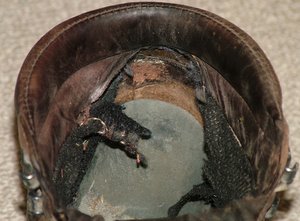
GORE-TEX® lining of each boot had come apart at the heel. This exposed the foam lining underneath, which was wearing away, with the remnants of it attaching itself to my socks and causing friction. Ideally, if there is any movement of the foot within a boot, the sliding should take place between the sock and the boot, not between the foot and the sock. In this case, because the wear exposed a material, i.e. foam, that was not smooth, and the socks built up numerous lumpy attachments from the foam, the socks started to cling to the boot and this resulted in a lot of rubbing between my socks and my feet. This started after only about 150 miles and caused me quite a bit of discomfort for the latter part of the walk.
Water Resistance
For the time that I had these boots, they performed very well, although much of the walking I did in them was on hard tracks and roads. However, I did cover a number of sections through long, wet grass and boggy terrain, where they kept my feet quite dry. However, as I did not have them for the same length of time as usual, I didn't have chance to give them a very good evaluation.
Wear
Again, as I only walked about 250 miles in these boots, it was not possible to establish how long they would have lasted. They showed very little signs of wear in general, with the exception of the wearing away of the lining at the heel.
Good Points
Very comfortable, needing little breaking in
Good foot protection
Good grip
Good water resistance
Bad Points
Wearing away of lining at heel causing blisters
General Assessment
My general impression of these boots was that they were very well designed for comfort, support and durability. It was only when I started to have problems with the lining of the heels that my impression of them took a turn for the worse. This is not a problem that I have experienced with any other boots, except for my Line 7 fabric boots towards the end of their life, and these didn't cause my heels any problem, it was just that the GORE-TEX® lining wore through. Part of the problem arose from the provision of soft padding inside the boots. This was very good for comfort but, in the absence of a durable covering, allowed wear to take place and destroyed my initial impressions about the boots. Most conventional leather boots have little or no soft padding and, therefore, do not suffer this problem. I was bitterly disappointed when this happened, as I was so pleased with these boots at
the outset and was sad that they had let me down in this way. They were only five weeks old when I had finished the Southern Upland Way so, rather than trying to find a way round the problem myself, I felt I had every justification to return them to the shop. There was no problem in getting an exchange, although I must admit that I didn't disclose that I had walked over 250 miles in their short life.
As I still needed another pair of boots, I tried on various other ones in the shop and found some of the same make but of a more conventional leather construction, which fitted my feet very well. They were £10 less than the others, which was refunded to me, and I only hoped that they would not suffer any similar problems.
Montrail Cristallo Leather Boots
Montrail Cristallo Boots after 240 Miles
General view of Montrail Cristallo boot
Little wear to sole
Folds in lining of heel caused discomfort and eventually wearing through
Leather cracked and hole formed
Sole and heal worn thin in places
Lining of heel disintegrated
£75 in 2003 (reduced from £110) - (equivalent to £160 approx in 2023)
Comfort
I obtained these boots as an exchange, having had an unfortunate problem with wear to the lining of the heels in my previous Montrail boots. I was a little sceptical about buying boots of the same make, but they were the only ones in the shop that fitted me comfortably and they appeared to be very good value at a sale price of £75.
Unlike my previous Montrail boots, these were of a more conventional
leather construction with comfortable padding in all the right places. They fitted comfortably from the start and, although the leather was quite stiff at first, and the footbed very rigid, I had very few problems breaking
them in. The solid footbed, which helps to provide good support and stops sharp objects from hurting the feet, however, can cause a lot of foot-ache on a long walk. Knowing the problems that this can cause, I fitted them with cushioned insoles and my home-made arch supports in an attempt to prevent this at the outset. The only problem that I encountered from the start was with the lining of the heels. Although they had a thinner lining than my
previous Montrail boots, where this curved around the inside of the heel, it went into folds and creases, with a particularly bad fold in the right boot. After a few miles of walking, the rubbing from this made my heel sore.
This did not confine itself to the right foot, as the left foot also gave trouble after a longer distance.
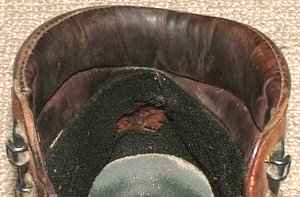
Eventually, after about 200 miles of use, these folds flattened more and the lining developed a smoother surface, both of which helped to reduce the problem. However, as can be seen from the photograph above, the lining has been worn through on the worst crease. In practice, this did not impair the performance of the boots, as the lining does not provide a waterproof barrier, but is, I think, merely for comfort! It did, however, cause problems by rubbing and wearing out my socks at a much faster rate than normal. After several hundred miles,
the lining broke down more and more, exposing foam underneath until this in turn wore away. The end result was that I got less and less problems as time went on, making me think that they would have been better without a lining around the heel in the first place.
Water Resistance
For most of their life, these boots have proved as waterproof as I would expect from a good pair of leather boots. It was only in the latter stages of their life that the leather started to crack in places, which started letting in a little water. Finally, one of these cracks opened up leaving at first a split and then a hole through which my sock was visible, and this finally put paid to their use in the wet.
Wear
These boots have worn very well, giving me well over the 1,000 miles of use that I expect from a good pair of boots. Towards the end, the tread on the soles and heels was wearing thin in places, resulting in reduced grip, the leather was cracking in several places, and the rand was separating from the leather. However, these were all to be expected after this length of service and I would rate them as very good boots from this point of view. The extensive wear to the lining round the heel that occurred later in their life was actually an improvement, as it reduced most the rubbing of my socks and heels that had occurred earlier on, making them very comfortable to wear over long distances.
Good Points
Good foot protection and support with a sturdy feel to them
Good grip
Good water resistance
Bad Points
Problems with soreness caused by folds in lining of heels. This diminished as the lining of the heel wore away.
Excessive wear to the heels of socks caused by the boot lining.
General Assessment
My general impression of these boots is much the same as that of my previous pair of Montrail boots - potentially they could be excellent boots. They are basically well designed and constructed for the most
part, but are let down by one poor feature. It is surprising that both pairs of Montrail boots I have had, with considerably different design and construction, suffer from similar, though not identical problems. Although I have suffered a whole host of problems with other makes of boot, I cannot remember any of them causing me this sort of problems with the heels. Of course, in many boots of a cheaper construction, there are not the niceties of soft linings but, if a manufacturer goes to the trouble of putting in a lining then they should, at least, make
sure it is fit for the job and doesn't cause more problems than if it had not been there. Again, I feel that in most other aspects these are excellent boots, but they are let down by a relatively minor aspect of design which should have been sorted out before putting them on the market.
Scarpa Ladies' Leather Boots
Scarpa Boots after over 1350 Miles
General view of Scarpa boot - still looking good
Still plenty of tread remaining on soles
Wearing away of padded lining on left boot, causing excessive wear to socks
Extreme breakdown of padded lining on right boot
Cost
About £50 in 2006 (equivalent to about £98 in 2023)
Comfort
Having had very good service from my Berghaus boots, I would have liked another pair the same. However, I couldn't find the same ones, or anything similar by Berghaus that fitted me properly, so I decided on these Scarpa boots, which seemed to be of a similar construction and fit. Sold as Ladies' boots, they didn't seem much different from men's boots so I didn't see why this should put me off buying them. They proved to be a good choice and gave a similar level of excellent service. There were a few differences in construction, which affected their comfort and performance. They did not have a hard plastic footbed, but a leather one, which meant that there was a little more feeling of sharp objects under foot and a little more flexibility to the boot. However, this did not make a great deal of difference to the comfort, as I fitted cushioned insoles, which I find are a necessity for long distance walking. The padding around the ankles was not as soft as that of the Berghaus boots, so they were not quite as comfortable in that area, but this did not cause me many problems. They took very little breaking in and caused my few problems throughout their life.
Water Resistance
These boots were not of a one piece leather construction and had one seam on the outside and two seams on the inside. This gave them the potential to catch on things, putting a strain on the stitching, and also gave more possible places for water to enter. In practice, although it was apparent that some catching of the seams had taken place, it was not enough to damage the stitching. These boots proved to be reasonably waterproof for much of their life provided that that they were kept well waxed. As with most leather boots I have had, cracks eventually appeared in the leather where it flexed most, and this allowed water in to an ever increasing degree. This started to become a problem at about 1,000 miles and, after another few hundred miles, was bad enough for me to abandon them in favour a new pair of boots.
Wear
Even after 1,350 miles, the boots were not excessively worn and they had managed to remain in quite good shape with the rands still attached in most places and without any problems from worn stitching or damaged lace hooks. The only real problem was cracking of the leather, which eventually allowed water to enter and sealed their fate.
Good Points
Good comfort, needing little breaking in
Long lasting and very durable
Kept good appearance
Good foot protection
Good grip
Good water resistance for much of their life
Bad Points
Not a one piece leather construction making them less watertight
Eventual cracking of leather, but only after long service
Extra insoles needed for comfort, as with most leather boots
General Assessment
These were a good, reliable, sturdy pair of boots offering a good level of comfort. They were not quite as comfortable as my previous Berghaus boots, which had softer padding around the ankle but, nevertheless, they did not take a lot of breaking in and gave some excellent service over a long mileage. As I had to pay the full retail price of over £90, they were not as good value as the Berghaus boots that I got in a sale. However, it is very much a matter of luck to find boots of the right size and fit at a cut price, and they still represented good value for the long, trouble free service that they gave me. I would quite happily have bought
another pair as a replacement but, as always, models change, as do prices, and nothing similar was available in the same price range when I came to buy another pair. The newer Scarpa boots were pitched at somewhat over a hundred pounds, so I looked at alternative makes at more reasonable prices.
Brasher Hillmaster II GTX Leather Boots
Brasher Hillmaster boots after 1100 Miles
Note: I now measure mileage using my GPS, which generally gives about a 10% higher figure than that measured from maps.
General view of Brasher boot - still looking good
Still plenty of tread remaining on soles
Wearing away of padded lining but not as badly as some boots
Rand starting to become detached in places, but not too badly
Some minor cracking of leather where it flexes
Cost
£120 in 2009 (equivalent to about £217 in 2023)
About the boots
In recent years I have generally been able to find good boots at discounted prices, but this time there ware very few boots available in my size. After exhausting the available stock in my favoutite discount store, I tried another shop that was offering very little in the way of discounts, but had a wider range of boots to choose from. The ones that most suited me were these Brasher leather boots, and when I tried them on, they fitted perfectly and felt extremely comfortable right from the start. I had also heard from other walkers that their Brasher boots had given excellent service, so I decided to raise my price limit, hoping that this would be justified in the longer term. The only reservation I had at the outset was that they tapered down towards the back of the ankle more than most other boots, and I was concerned that it would be easier for water to come over the top when walking through streams or boggy places. I presumed, however, that there was some good reason for this shape to be chosen - possibly to allow more freedom of ankle movement when walking or climbing over rough terraine. The main problem I had experienced with my last few pairs of boots had been the rapid breakdown of the padded lining at the back of my heel, so I was pleased to see that these boots had a lining of what appeared to be soft leather where most rubbing was likely to occur, so it was less likely to wear away.
Comfort
I was so impressed with the comfortable fit and feel of these boots that I ignored all the normal rules of breaking them in gently, as I couldn't believe that they would give any problems. The first walk I did in them was a winter mountain walk of about 11 miles with a lot of walking on rough and steeply sloping ground covered in tufty grass and through boggy areas with even worse tufty grass. It was not long before my heels started rubbing and getting sore. Matters were not helped when my feet got wet by going through boggy areas where the water was too deep. This may also have been made worse by the low height of the backs of the boots, which would only keep out water about an inch or so less in depth than most other boots I have had. The result was that I had a blister on the back of each heel by the time I had finished. Much of this I blame on myself for my overconfidence, which had arisen from first impressions. Had I started with a few periods of easier walking, some of the discomfort could have been avoided.
Subsequent walks proved more satisfactory, though I still had a tendency to get sore heels on many occasions. However, this has tended to be a problem for me for a number of years and may be due to factors relating to age rather than being the fault of my boots. With age, I have found that I have less fleshy padding on my bones, so there is more likelihood that rubbing will cause discomfort and blistering.
When I bought the boots, I was informed that they had memory foam in the padding around the heels and ankles. I cannot say that I noticed a great deal of difference when wearing them, though I can say that throughout the life of the boots so far, I haven't suffered any soreness on my ankle bones that has sometimes happened with other boots, so maybe the memory foam has helped in this respect.
Water Resistance
Despite the fact that these boots did not have a one-piece leather construction, their water resistance has not suffered as a result of any joins in the leather. Most boots are quite good at keeping out water in the early stages, but this can deteriorate badly lowards the latter part of their lives. These Brasher boots are still very good at keeping out water after over a thousand miles, even when they have not been waxed for some time. The main problem in the wet, as mentioned previously, is when the water is a bit too deep and enters over the top of the back of the boot, whereas boots with a higher construction may have managed to keep it out. In general, however, these are some of the best boots I have had for keeping my feet dry throughout the whole of their life so far. They have a GORE-TEX® waterproofing layer between the outer leather and the lining; the first leather boots I have had with one, so this explains why they are so good at keeping out the water. It also explains why they can get away without having a one-piece construction and also means that, if the leather starts to crack right through, they should still remain reasonably waterproof, and this could well extend their useful life even further.
Wear
Nearly everything about these boots has stood up well to a lot of rugged walking through all sorts of conditions, and the general level of wear and tear is still very good beyond the thousand mile point that I expect boots to reach whilst still being serviceable. There has been some wear through the lining by the heel, but this has only worn through fairly recently giving them a far better performance than many other boots I have had. Wear like this inevitably leads to more problems with sore heels and blisters, and can lead to excessive sock wear when abrasive padding is exposed, though in this case the effect has not been too bad, as the padding that has been exposed is not at all abrasive, so I can still see them giving me useful service for another few hundred miles. There are signs of cracking in the leather where it flexes, which is generally to be expected, but this is not yet serious and it is likely to be quite some time before it is bad enough to allow water through. Tread on the soles is still deep enough to give good grip and is less worn down than might have been expected at this mileage, so overall these boots have performed very well.
Since taking the photographs, I clocked up another five hundred miles in them, making a total of about 1600 miles by which time the leather had cracked quite badly and the soles were getting thin. However, despite holes through the leather they were still more waterproof than many other boots were when they were new thanks to the GORE-TEX® lining still remaining intact.
Good Points
Felt very comfortable from the start
Long lasting and very durable
Kept good appearance
Good foot protection
Good grip
Good water resistance throughout their life
Bad Points
Initial comfort gave way to soreness of heels at times
Back of boot very low allowing water to flow in at times
Not a one-piece leather construction, though in practice, this was not a problem
General Assessment
Overall, these boots have given a very good performance and have been as good or better than many other similar boots in most respects. There have been some minor failings with regard to discomfort at the back of the heels, but this can vary from person to person and also depends on walking conditions and several other factors, so is not necessarily a failing of the boots themselves. The low back of the boots may have some advantages such as allowing freer movement and less rubbing of the ankles, but also has some disadvantages such as allowing water in more readily and giving less ankle support in certain circumstances. It very much depends on what type of walking is being undertaken as to whether one outweighs the other or vice versa. These are the most expensive boots I have ever bought, even allowing for inflation, but this is partly because I was unable to get them at a discounted price. However, they have lasted about 50% longer than most of my other boots, so in terms of cost per mile they come out very well. I have been very pleased with their comfort, quality and durability, so I would have no hesitation in recommending them to anyone.
When it became apparent that these boots had reached the end of their days, I decided that I would really like another pair of the same, because I had been so pleased with them. Still somewhat concerned with the high price tag, I decided to look online to see if I could get them cheaper. In normal circumstances I would not do this because I have always felt that I have to try boots on before buying, especially as I have wide feet and a high instep which often causes difficulties in getting a good fit. However, in this case I knew that the fitting would be the same as my old ones, so I felt much safer about not trying them on first. Consequently I got the next pair for only £90 in December 2014 and they have been serving me well since then, though I have not been doing as much walking as I used to do. The design has changed only slightly since I bought the previous pair, so I have not shown another set of photographs. They are every bit as good as my first pair, so I expect to be wearing them in comfort for a good few years to come.
Brasher Hillwalker II GTX Leather Boots
Please note that since 2014 Brasher has been owned by Berghous, so their boots currently (2017) have both names on them. The brand name Brasher is now being phased out, but the same boots will be sold using only the Berghaus name.
Brasher Hillwalker II GTX Leather Boots after 820 Miles
Note: I now measure mileage using my GPS, which generally gives about a 10% higher figure than that measured from maps.
General view of Brasher boot
Still plenty of tread remaining on soles
Right Boot - stitching starting to fray plus wear to leather near sole
Left Boot - leather completely detached and hole through GORE-TEX®
What might be called 'Well Ventilated'
Cost
£90 in December 2014 - Internet Price (equivalent to about £135 in 2023)
About the boots
I had had such good service from my previous pair of Brasher boots that, when they finally neared the end of their days after 1600 miles of walking, I decided to go for another pair of the same. Generally, I have looked around shops with discounted prices and just taken anything that felt reasonably comfortable that was being sold at a reasonable price. I had deliberately never bought online because, having feet of an awkward shape (wide with a high instep) it was always necessary to make sure of a comfortable fit, which is best done in a shop. However, having decided on the same boots again, I knew that they would fit properly, so I could just look for the best value and was able to get some for £90 including delivery.
When I tried them on, they felt comfortable from the start and my first walk didn't reveal any problems, so I was perfectly happy. I did, however, notice slight differences in the design and was a little surprised that they were sold with what I thought was exactly the same name, though there was nothing that concerned me and I even thought them to be better as they were lighter in weight. All was well for two and a half years in which I did about 700 miles without any concern, thinking that they would last me for another 700 miles or more judging by experience of the previous pair. In July 2017, I was just getting ready to walk the last section of the Cambrian Way when I noticed that some stitching near the sole of my left boot was showing sign of fraying and the leather itself some signs of wear. I was almost about to set off, so there was no time to get new boots and I would just have to set off and hope for the best.
Despite the fraying of the stitching, the boots performed perfectly well and the left boot did not let in any more wet than the right boot (I had some very wet weather so neither stayed perfectly dry). As the walk progressed, however, the leather became detached and eventually there was a large loose flap, exposing the inner GORE-TEX® layer, which was still doing a sterling job of keeping the water at bay. I hardly noticed anything wrong whilst I was walking, as they still felt firm and stable, though I could feel a bit more cold when I walked through puddles. By the last day but one, the situation had deteriorated further, when a big hole appeared in the GORE-TEX®, allowing water to run in and out quite freely. Miraculously, I was able to reach the end of the walk with nothing more than a wet foot, though I had so much wet to contend with that my feet were seldom dry anyway. In any case, the water that flowed in freely could flow back out again with the same ease. The right boot, though largely still intact, was showing signs of wear in the same place, but only about the same as the left boot was at the start of the walk.
When I returned home, I started to compare the boots more carefully with the previous pair and realised that there were significant differences. For one, the material used inside around the ankle and tongue was fabric rather than the soft leather of the previous ones. More significantly, the rand, which is a strip of rubber running round the join between the sole and the upper, was missing completely on these boots. Therein lay the problem, as there was nothing to protect the lower part of the leather upper from sharp stones, hence the excessive wear. It was only when I started investigating this that I realised that they were actually two different models: the first pair being Hillmaster II GTX and this pair Hillwalker II GTX and I had just failed to notice. I have now bought a new pair of the Hillmaster boots for £99 online (Retail price £160), whereas the Hillwalker boots have a retail price of £130.
Comfort
The comfort of these boots was extremely good right from the start, and I had no real problems in breaking them in unlike many other boots. In fact there was not even much breaking in to do apart from a slight rubbing on my ankle bones. This is one of the things that Chris Brasher, the late owner of the company, set out to achieve after suffering problems from other makes of boot himself. They remained comfortable throughout their somewhat short life. These are considerably lighter than many boots, which makes for easier walking, and they are quite low at the back to allow easier ankle movement, though this can result in water entering from deep puddles, as mentioned below.
Water Resistance
One of the important features of these boots is the GORE-TEX® lining, which ensures that, even if wet manages to soak in through the leather or creap in through the stitching, feet are still kept dry. In very wet weather, I have never found any boots that keep my feet completely dry. Even if water does not enter the boot through the material, socks can get wet and some of this can soak down into the boot. Also, in deep puddles water may come over the top of the boot and enter that way. Even without those possibilities, sweat from feet can also make the feet damp in some conditions. With these boots the back of the boot is rather low to allow freer movement of the ankes, this can sometimes result on water coming in this way, but there is a compromise between easier ankle movement and protection from water, so I was prepared to accept this. Overall, I would rate these very highly for their water resistance, being among the best I have experienced.
Wear
Unfortunately, this is what let these boots down in my case, as the rugged walking that I undertake caused premature wear in the leather near the soles, which was noticeable after 700 miles and resulted in catastrophic failure after 800 miles. This could have been largely prevented had there been a rand around the boot to protect them. I hasten to point out, however, that much of my walking is done over rough and craggy terrain and, in places, there are very sharp rocks sticking up that can cut into the leather. For someone who does most of their walking on good paths and smoother ground, I am sure that they would give much longer service, and the advantages of having lighter and more flexible boots (I think the leather may be thinner as well) can be an advantage much of the time. If there is not a need for a very sturdy boot then the lower price tag is also a good reason to buy these. Other things such as the tread and the lining showed very little sign of wear, so they would easily last for several hundred miles more.
Good Points
Felt very comfortable from the start
Lightweight and supple
Good grip
Good water resistance throughout their life due to GORE-TEX® lining
Bad Points
Lack of rand allowed leather and stitching to wear badly over rough terrain
Reduced life in rough walking conditions
Back of boot rather low allowing water to flow in at times
Not a one-piece leather construction, though in practice, this was not a problem as GORE-TEX® kept out water
General Assessment
These boots were very disappointing as far as I was concerned because of the amount of walking I do over rough terrain, which resuted in a much short life than I anticipated for the price. However, I could not fault them for their general comfort, which started from day one. They were also very good for keeping my feet dry until they started to come apart towards the end of their life. I could well see that under gentler walking conditions they could last for much longer and be much appreciated for their comfort and light weight. It is just a matter of horses for courses and, for rough terrain, a tougher boot is required.
Next Pair of Boots
Having seen the deficiences in the Hillwalker boots for my type of walking, I decided to go back to the Hillmaster ones like like I had before them, having finally worked out the difference between Hillwalker and Hillmaster. In September 2017, I bought another pair of the Hillmaster boots for £99 online with free delivery in September 2017. Unfortunately, I decided to order a size larger than my previous ones so that there was more room for thick socks and insoles. I was also confused about sizes because boots, especially those made in Europe, had continental sizing and not the British sizes that I was used to and there was not always an exact conversion to go by, and this may have added an extra to the size as well. This didn't work out so well as it meant that the front part of the boot extended too far beyond the point where the flexing takes place at the bottom of the laced part. This made them unstable on steep descents, affecting my balance which was already deteriorating with my advancing age. I was able to use them until they were getting sufficiently well worn for replacement so I didn't lose out too much on them and my general comments would be very similar to those I made about the pair I had previously.
When it came to buying a new pair I had no hesitation about buying another pair of the Hillmaster boots the same size as the first pair I had had. I would generally not recommend buying any boots before trying them on first. However, in this case I was confident enough to buy a pair online at a discounted price, saving me from hunting around boot shops to find them. Of course, online sellers are generally prepared to have boots returned if they do not fit or they are not to one's liking and I was offered this when I bought them. As expected they fitted well. So far I have not walked very far in them, but I am sure they will give the service that my earlier pair did. Again, these were comfortable from the very start and the fine quality stood out immediately. To date (Jan 2024) I have done over 400 miles in them and they are still in good shape.